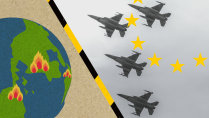
On the militarisation of the European Union

In our work on peace here in Brussels, QCEA is using the lens of militarisation to analyse the changes in the defence policy of the European Union over the last fifteen years. But, what do we mean by militarisation and why should it worry us?

What is militarisation?

Armed Forces Day

Armed Forces Day is celebrated on the 29th June each year in the UK. Credit: Press Centre, United Kingdom Crown Copyright.

I understand militarisation to be the process by which the presence and the approaches of the military are made normal1. It is a complex and multifaceted process that can occur at all levels of society; both within and across state borders. The process may not necessarily have any geographical, economic, or political boundaries, and, as such, it can be hard to recognise, never mind quantify. Is education militarised if the armed forces are granted privileged access to schools and universities for recruitment? (The British government has been criticised for this). I would say it is. In the UK, the introduction of an ‘Armed Forces Day’ at which you “Show Your Support” for the military is another example of the militarisation of society. In contrast, we could describe relations between two countries as becoming or being militarised, as in the Cold War between the US and the USSR or on the Korean peninsula today. Azerbaijan’s massive increase in military spending over the last decade indicates a militarisation of the Caucasus. At first, we might find it hard to compare education policy with inter-state arms races, but the lens of militarisation shows us an important similarity in both. They are indicative of, and at the same time promote, a certain way of thinking, namely, militarism: the idea that war is inevitable and that preparing for war is thus a good thing to do.

That militarisation can occur on so many levels and manifest itself in so many different ways forces us to be both astute and creative in how we identify and measure it. In situations of tension between different states, we might look at increases in military expenditure or the rhetoric of political leaders. At the national level, say in education policy, we might look at the numbers of military personnel visiting schools or the significance given to military history in the national curriculum. Social attitudes are important too. In the US, for example, uniformed military personnel are allowed to board civilian flights on certain airlines before anyone else, including women with children. What does this say about American society and how it sees the military and war? We cannot (despite attempts to do so) build up a picture of militarisation that fits neatly on to a linear scale running from ‘demilitarised’ to ‘militarised’. It is, instead, a complex process that requires a rich and creative approach in order to be understood and challenged.

The militarisation of the European Union

EU High Representative for Foreign Affairs flanked by Chair of the EU Military Committee and the head of the EU Military Staff. Credit: The European Union

EU High Representative for Foreign Affairs flanked by Chair of the EU Military Committee and the head of the EU Military Staff. Credit: The European Union

When looking at the militarisation of the European Union, our eyes are firmly focused on the growing credence given to the EU as military power over the last fifteen years. Since the St. Malo declaration in 1998, we have seen significant developments in a coordinated EU foreign and defence policy. The Common Foreign and Security Policy and the Common Security and Defence Policy are now accepted parts of the daily workings of the EU institutions. There is an agency that is institutionally, if not politically, independent from the Commission and Council, devoted exclusively to foreign and defence policy: the European External Action Service (EEAS). There are currently 176 military personnel working in the EEAS; fifteen years ago the number of military personnel employed by the EU was significantly smaller. The presence of uniformed military personnel in the EU today reflects the normalisation of military approaches here in Brussels. The European Defence Agency, the EU Military Staff, and the EU Intelligence Centre, all created in the last fifteen years, are also indicative of the militarisation of the EU. The EU is increasingly being seen as possible guarantor of European security, though colossal questions remain as to how this might happen and what role NATO will have.

In addition to the growth of military structures, there has been a militarisation of other areas of EU policy. In 2004, the Commission began funding a “security research” programme, the aim of which, somewhat ambiguously, is “to protect Europe’s citizens and society from harm”. The programme, which is now in its ninth year, has awarded funding to major weapons manufacturers, including BAE Systems, Finmeccanica, Thales and EADS. The involvement of the arms trade is itself concerning, but most criticism focuses on the content of the research. As documented by TNI Fellow Ben Hayes, research is being carried out into drones that will patrol Europe’s borders to try to stop irregular migration. But, are the people trying to cross European borders the real problem? Perhaps the solution lies instead in understanding and addressing the global socio-economic inequality which drives migration and in changing the broken Dublin II regulations. The security focus in EU policymaking is not limited to migration: similar thinking is present in climate, energy and health policy. This approach is another example of the militarisation of the EU, because it rests on the idea that violence – or the threat thereof – is an effective, and often the only means to achieve political and economic ends.

                Why oppose militarisation?

Although we might be tempted to say that the answer to this question has already been provided by others, it is important to remember why we should expose and oppose militarisation. In order to engage in discussions at the European level, we need considered and comprehensive responses to complex policy questions, not just a nebulous unease at institutions which accept and promote the use of organised political violence. The greatest criticism we can lodge at militarisation is that it does not achieve what it sets out to achieve. This can be summed up in the famous quotation of A. J. Muste: “There is no way to peace, peace is the way”. He means to say that we cannot achieve peace through violence: the two are antithetical. In fact, it is through actively choosing not to be violent that we come to peace. Is militarisation thus a self-fulfilling prophecy? Yes, in militarising, not only do we walk away from peace, but we walk towards violence.

Holding Faith

David Gee describes peace as: “to bend towards a relationship with the world that allows fundamental needs to be met in life-giving rather than life-destroying ways, and to work for a society in which that choice becomes more possible to make.”

Consider this with regard to the militarisation of the European Union. If, as the founding treaties of the EU assert, we are working for peace and prosperity both within and outside of Europe’s borders, then it is only by creating and implementing peaceful policies that this vision will be realised. The current EU military structures are often described as “humanitarian”; that is, designed to aid with peacebuilding, development, and conflict prevention. But some commentators, referring to the very same structures, propose that the EU should become a military alliance whose goal it is to secure European global influence. The more this latter thought is consolidated in the minds of the public and policy makers, the more the EU will direct its energies away from peace rather than towards it. It is for this reason that we should be concerned by the militarisation of the EU and for this reason that we should advocate the more effective, nonviolent alternatives. In his book Holding Faith: Creating Peace in a Violent World David Gee explains that peace is not “an ideological view about the moral failure of violence, but a practical expression of a feeling for what life and society are really about”. Opposing militarisation is precisely this.

With thanks to Owen Everret from Forces Watch UK and War Resisters International for help with definitions. See Owen’s article on ‘Nuclear Weapons and Militarisation in the UK‘ for a UK-focussed discussion on militarism and militarisation. Contact Chris for more information on QCEA’s work on the militarisation of the EU: @chrisjvenables or cvenables [at] qcea.org

Posted in Peace | Tagged , , , , , , , , , , , , , , ,

Overwhelming Citizen Response in EU Fracking Debate

If you’re reading this in Europe, the likelihood is that you are sitting not too far from shale gas reserves, or even on top of them. The map below shows Europe’s major unconventional natural gas resources (shale gas and coalbed methane). The extraction of this gas, via the process of hydraulic fracturing (fracking), has been hailed as a ‘game changer’ in the US owing to its short-term contribution to energy security and prices.

QCEA agrees that shale gas will indeed be a game changer, but not in the positive way that this is often interpreted.

Unconventional Natural Gas Resources

Source: Eberhart et al. (2013), The Right to Say No: EU Canada Trade Agreement Threatens Fracking Bans, published by the Transnational Institute, Corporate Europe Observatory and the Council of Canadians.

Shale gas will be a game changer in the EU’s efforts to meet its climate change targets. (The EU aims to reduce its carbon dioxide emissions by 20% by 2020. It is currently discussing more ambitious targets for 2030, and these will contribute to an overall target of reducing carbon emissions by 80% by 2050.) Some proponents of shale gas argue that it is a more climate-friendly fuel, as the combustion process releases less carbon dioxide than many conventional fuels such as oil and coal. Whilst this is may be true, it is also extremely misleading, as the process of extracting shale gas can release methane, a much more powerful greenhouse gas, into the atmosphere. Some will tell you that this is no more than a minor risk as only 5% of wells initially leak methane. What they fail to mention is that the risk increases to 50% over the life of the well, which must be maintained indefinitely, even after it is no longer being used.1 An important thing to know is that hundreds, and in many cases thousands, of individual wells are required in one ‘play’, or area of shale gas extraction, in order to efficiently extract a profitable quantity of gas. Taking these figures into account makes it clear that the risk of methane leakage is in fact significant, and the argument that shale gas is a more climate-friendly fuel does not stand.

Shale gas will also be a game changer to those of us who live near to fracking sites. As experience has shown, we will risk contaminated drinking water and soils, and consequently threats to our health and that of our community. The contamination can result from both methane leakage and also the mixture of chemicals that are injected into the ground in order to force apart the rocks from which we extract gas. 80% of this waste water remains underground, where it may contaminate groundwater. The rest of this contaminated water is expelled above ground, and our municipal water systems are not equipped to treat this waste.2 Other concerns of local people include increased traffic and noise pollution.

It will be a game changer for wildlife and biodiversity, which is far less resilient than we are to water and soil contamination. Shale gas exploration is already venturing into certain Special Areas of Conservation, supposedly protected by the EU Natura 2000 scheme. The impacts of fracking will directly contradict the EU’s headline biodiversity target which pledges to “halt the loss of biodiversity and the degradation of ecosystems services in the EU by 2020.”

These profound and far-reaching implications have not gone unnoticed by the European public. In responding to a recent European consultation on the opportunities and challenges of unconventional fossil fuels (e.g. shale gas) in Europe, over 22,000 European citizens exercised their right to have a say in this debate. This response was described as “overwhelming” by the Commission, who often receive only 100 to 200 responses to online consultations. The public voice on this matter must not go unheard. In my next blog, I will discuss developments in European policy, and how we can encourage transparency, open debate and accountability on such a divisive and important issue.

1 Thomas Porcher, author of Le Mirage du Gaz de Schiste, Speaking at the The Fracturing of Public Opinion Debate, 27Th May 2013, Brussels.

2 Eberhart et al, (2013) The Right to Say No: EU Canada Trade Agreement Threatens Fracking Bans, published by the Transnational Institute, Corporate Europe Observatory and the Council of Canadians, p7

Posted in Democratic Accountability, Sustainable Energy Security | Tagged , , , , , , , , , , , ,

Transitional Justice and Gender Sensitivity: Challenges and Opportunities

Transitional Justice is a range of mechanisms and processes to allow a society to come to terms with a legacy of past human rights abuses, in order to ensure accountability, serve justice, and achieve reconciliation within and between communities and peoples. It incorporates both judicial and non-judicial mechanisms. Examples of what transitional justice might include are: truth and reconciliation through inquiries and tribunals, prosecution and compensation to victims, as well as institutional reform. Transitional Justice measures are applied today in fragile and post-conflict settings where state and economic infrastructure may be weak. The positive effects of Transitional Justice may only be visible decades after a conflict has ended, yet it is still imperative that it functions, in order to re-establish the rule of law, enable societies to come to terms with the human rights violations they have lived through and rebuild a country post-conflict.

Gender and Transitional Justice

Flag of the United Nations cc Wilfried Huss / Anonymous

Flag of the United Nations
cc Wilfried Huss / Anonymous

Incorporating a gender approach in international relations and international policy-making is crucial to development and peacebuilding. For example, the UN Security Council Resolution 1352 (2000) on Women, Peace and Security urges all people involved in peace-keeping to increase the participation of women and incorporate gender perspectives in all United Nations peace and security efforts. This is not only to address previous exclusion of women in peace and security, but also because women are seen to bring different views and ideas to the table when dealing with such issues as Transitional Justice. But, how do we go about applying this gender perspective to post-conflict situations? How is a gendered approach realistically incorporated into and through Transitional Justice processes? What problems and challenges arise from this approach?

On Friday 26th April, we, Imogen and Chris, participated in a European Peacebuilding Liaison Office (EPLO) Brown Bag Lunch: “Transitional Justice and gender sensitivity: Challenges and Opportunitieslead by Karlijn Leentvaar, Programme Manager at Impunity Watch. She presented a background discussion paper, “Recurring Obstacles to Gender Sensitivity within Transitional Justice”, and described Impunity Watch’s research into the consideration of gender in the truth, justice, reparations, and non-recurrence processes (TJRNR) in three countries: Guatemala, Burundi, and Bosnia-Herzegovina. Representatives from NGOs such as the Causeway Institute for Peace Building and Conflict Resolution (CIPCR) came together with the European External Action Service (EEAS) in the seminar. Examples of gender sensitivity in Transitional Justice in countries such as Afghanistan and East Timor allowed different examples to be used to refute and support Impunity Watch’s findings.

The challenges of a gender sensitive approach to Transitional Justice

Women and children in Herat Afghanistan cc Marius Arnesen

Women and children in Herat Afghanistan
cc Marius Arnesen

Patriarchal social structures and cultural norms of many societies pose great challenges to gender sensitivity in many post-conflict situations. Impunity Watch asks the following question: “Do cultural and inherent gender roles and perceptions play a role [in the effectiveness of a gender sensitive approach in transitional justice]?” A point was made that in Afghanistan there is the danger of cultural imperialism and that international bodies such as the UN are viewed as “Western” and neo-colonial, something to be wary of. The war in Afghanistan is heavily bound up with the concept of liberating women from constrained social roles. In 2001, Laura Bush, the wife of George W Bush, made the following statement: “because of our recent military gains in much of Afghanistan, women are no longer imprisoned in their homes…the fight against terrorism is also a fight for the rights and dignity of women”. Since she made this statement, gender has become a locus upon which both the Taliban and the ‘West’ play out their power games in reference to women’s (lack of) rights. In many situations, the focus of international policy also rests heavily on sexual violence prevalent in such ethnic conflicts as the Rwandan genocide in 1994 and the breakup of former Yugoslavia during the 1990s. During a recent briefing, the United Nations Special Representative of the Secretary General on Sexual Violence in Conflict, Zainab Hawa Bangura, stated that rape is now widespread in the Syrian conflict, where not only women, but men have been victims of sexual assault. This focus on sexual violence towards women is extremely important and necessary, but it also risks shifting the focus of the gender-sensitive debate away from the stigma experienced by men victimised by sexual violence.

Zainab Hawa Bangura cc United Nations Development Programme

Zainab Hawa Bangura
cc United Nations Development Programme

There is still a great acceptance that the mechanisms used for a gender-sensitive approach in transitional justice are difficult to define. It was highlighted in the discussion that progress in gender sensitivity in post-conflict situations can only happen if development aid and Transitional Justice mechanisms can target specific countries, regions and conflicts in an effective way. This is difficult in many post-war situations where the government and institutional structures are unstable, and short-term outcomes are hard to measure. Transition from instability to stability within a country may be long and arduous, and there are difficulties in measuring the impact of Transitional Justice practices, especially related to gender. It was mentioned in the seminar that donors and aid have become part of the problem in gender-related peace-building and transitional justice projects where large amounts of money are given to projects but the funds may end up in the hands of those who know the right words and donor jargon, and not used for the purposes intended. This is again because of the complexities of implementing gender specific Transitional Justice mechanisms due to the difficulties of pinpointing where aid must be concentrated for gender specific purposes.

Tunisian Flag cc US Army Africa

Tunisian Flag
cc US Army Africa

There was also discussion of the ineffectiveness and superficiality of quotas for women – the guarantee of a certain number of women in Parliament or the civil service. This is visible today in such places as Egypt and Tunisia, both countries in the process of transition since the uprisings of 2011. Tunisia was perceived as the pioneer of women’s emancipation in the Middle East and North Africa before the revolutions in 2011. The Muslim Brotherhood in Egypt, and Islamist party Ennahda, in Tunisia, used quotas of women in government for their political campaigns after the ‘Arab Spring’. This does not only happen in the Middle East. It was noted in the seminar that gender equality is still something we are tackling in Europe. For example, in rural parts of East Germany, which is seen as a European liberal nation with 204/620 seats in the German Bundestag (Parliament) held by women, women’s empowerment is still weak at the local level. “Western” countries are advocating for women’s equality and supporting a gender sensitive approach to Transitional Justice measures in countries marred by conflict across the globe, yet there is still a lot of work to be done at home.

Opportunities

After hearing the many seemingly insurmountable challenges facing the inclusion and mainstreaming of gender sensitivity in Transitional Justice – and perhaps even development policy more generally – it is tempting to conclude that development agencies and NGOs face an impossible task. If so, could they reasonably put gender to one side as an important issue, but one they don’t have the capacity to address? Absolutely not! First, it is in times of transition that the greatest potential for change exists. These situations hold the opportunity to address societal perceptions of gender. Second, what is needed is a more realistic assessment of the change that donors and development agencies can effect. The Laura Bushes of this world need to take a more nuanced approach when praising the achievements of Western organizations in developing countries. Third, we must recognise that our own Western societies still have a long way to go in achieving a more just and fair society for women. In recognising our own struggles, perhaps we will develop a deeper understanding of the people we are trying to help.

By Chris Venables and Imogen Parker

Posted in Criminal Justice, Human Rights, Peace | Tagged , , , , , , , , , , , , , , , , , , , , , , , , ,

Militarism in the European Union: The Defence Industries Task Force

“From the smallest to the biggest EU country, no Member State can guarantee security all alone”. So said Michael Barnier, Commissioner for the Internal Market, when announcing the creation of the EU Defence Industries Task Force. Formed in 2011, the Defence Industries Task Force is a Commission-led group which will deliver recommendations on how the EU could support the European arms industries. The group comprises representatives from many of the Commission Directorate Generals (DG), including Enterprise, Competition and Trade, as well as the European Defence Agency and the European External Action Service. Its recommendations will soon be adopted by the College of Commissioners in the form of a Communication to the Council and the Parliament. The Communication is not yet public, but members of the Task Force have spoken to the European Parliament and this, combined with media reports, means the content can be predicted with a reasonably high-level of accuracy. So, what might we expect?

Commission for the Internal Market Michael Barnier, the leader of the Task Force on Defence Industries. Credit: European Commission

Commission for the Internal Market Michael Barnier, the leader of the Defence Industries Task Force. Credit: European Commission

First, expect to read that supporting the arms trade, because of its direct link to military power, is essential to European security. The ‘capability shortfalls’ in Libya, the US ‘pivot’ to Asia Pacific, instability in the Middle East and North Africa, and new security threats such as migration and climate change, will be used to justify measures supporting European arms manufacturers. Supporting the arms trade is thought to directly sustain European military might. NATO Chief Rasmussen summed up this thinking a number of weeks ago when speaking to the European Parliament: “We Europeans must understand that soft power alone is really no power at all. Without hard capabilities to back up its diplomacy, Europe will lack credibility and influence”.

Second, the Communication will again attempt to bring the arms trade under the rules of the internal market. European arms manufacturers are still organised in national blocks and receive significant support, in the form of subsidies and preferential access to government contracts, from their ‘home country’. This support permeates even the highest offices of government. Since coming to power in May 2010, UK Prime Minister David Cameron has made numerous trips abroad to promote British-made arms. The Commission,  looking through the lens of competition and free markets, sees the European defence market as inefficient. As has happened with many former state owned industries, the Commission would like to see the defence market liberalised. It took steps in this direction in 2009 by introducing two Directives on defence procurement, but they have yet to be fully implemented by Member States. The Task Force is likely to recommend that they be given more credence. Article 346 of the Treaty of Lisbon allows Member States to exclude the procurement of “arms, munitions or war material” from the rules of the internal market, but the scope of the exemption is contested. In the Communication from the Task Force, the Commission may try to implement a more strict interpretation.

Third, the Communication will suggest that the Commission creates a strong ‘defence industrial policy’. This could be through creating common European standards for defence technologies and equipment; promoting regional specialisation defence technologies; providing support to small- and medium-sized enterprises; and opening up EU research funding to defence. The EU’s research funding is currently explicitly civilian in nature, but it has long been the goal of policymakers to use the Research Framework Programmes to develop military technologies. The Foreign Affairs Committee of the Parliament issued a strongly worded commentary on Horizon 2020, the next round of EU research funding, arguing that military research should be included.

~

All the proposals contained in the Communication are ultimately about supporting a strong defence sector in Europe. Whether its growth and jobs, or defence and security, there always seems to be a reason to support the arms trade. But, there are four reasons why these arguments are weak.

New technologies: the new 'Demon' drone being developed by BAE Systems. Credit: BAE Systems

New technologies: the new ‘Demon’ drone being developed by BAE Systems. Credit: BAE Systems

First, the military have a limited contribution to make to solving the security challenges and threats currently facing Europe as even the EU itself describes them. The EU’s European Security Strategy (and it subsequent update) pronounce the greatest threats to European security as climate change, energy security, arms proliferation, state failure, organised crime, and terrorism. If these are indeed the greatest threats facing European citizens, then it’s hard to see how increased military spending is going to solve any of them. If we are serious about tackling climate change, then developing new weapons system seems like an expensive distraction. Are we going to start shooting down CO2 as it enters the atmosphere? If we are concerned by energy security, then why do we not invest more in renewable technologies? Again, are we going to ‘secure’ our energy through the use of force? If we look carefully at the each of the ‘threats’ identified by the Security Strategy, not only do we find alternatives to military solutions, but we see that the nonviolent solutions are the best ones!

eu_milspending_crisis_cover

‘Guns, Debt and Corruption’, a report by Frank Slijper of the Transnational Institute.

Second, over the last decade, we have seen military spending across Europe increase systematically. And, whilst moderate cuts to defence budgets may see this trend reversing over the next few years, military spending is set to remain high. Defence expenditure in Western and Central Europe makes up around 28% of the global total, although Europe has only around 7% of the world’s population. Why does should this concern us? Well, a new report by the Transnational Institute argues that high military spending contributed to and is sustaining the current financial crisis. Their paper, ‘Guns, Debt and Corruption’, highlights the shocking fact that, at a time of austerity, EU military expenditure totalled €194 billion in 2010, equivalent to the annual deficits of Greece, Italy and Spain combined.

Third, the ‘jobs and growth’ arguments for supporting the arms trade which will be made in the Communication, are weak. Any policy making its way through the Commission at the moment must tick certain boxes. These criteria are informed by the Europe 2020 strategy; the Commission’s flagship initiative to promote economic growth. The Task Force will have to make the case that the arms trade is good for the economy. Aside from the fact that this way of thinking is irresponsible and ignores the highly political nature of arms manufacture, it is also bad economics. The arms trade in Europe exists to a large extent because of the huge support it is given by governments, not because it is uniquely competitive or has great potential for economic growth. If anything, the arms industry stifles growth by diverting resources away from sectors which have far more potential, such as renewable energy. As a 2004 report by BASIC, Oxford Research Group and Saferworld notes of the UK, “Far from providing jobs, government support for arms exports diverts investment away from more effective job-creating economic activity”. Or, in the words of the economics editor of the Financial Times: “You can have as many arms export jobs as you are prepared to waste public money subsidising”.

Air-to-air refuelling is something the European Defence Agency has been working on under its 'Pooling and Sharing' programme. Credit: European Defence Agency

Air-to-air refuelling is something the European Defence Agency has been working on under its ‘Pooling and Sharing’ programme. Credit: European Defence Agency

Finally, the Task Force and the Communication are a waste of EU time and resources. The Member States will be wary of the document and its proposals, and thus will be unlikely to respond in any meaningful way. The reasons for this are two-fold. First, industry has very little to gain from the liberalisation of the defence sector. Supranational policies such as ‘Pooling and Sharing’ may in fact spell the end of generous (and generally unquestioned) state support for the arms trade, without which profits would be in serious trouble. Jobs losses and factory closures generally terrify governments. Second, given the unsteady ground upon which European Union finds itself, Member States are unlikely to commit to further integration in the area of defence; the future of the Common Defence and Security Policy (CSDP) is unclear and uncertain. The European Council plans to discuss defence this December, but outcomes are likely to be minor.

With all the challenges facing Europe right now, the Commission should not be focussing on an industry which has so little to contribute.

Posted in Peace | Tagged , , , , , , , , , , , , , , , , , , , , , , , , ,

Landscape and history

I recently had an opportunity to do some walking around what Quakers call the ‘1652 Country’. To those, like me, who are not very familiar with English geography, let me explain that this is north of Lancaster, on the western side of the narrow bit of England between the bulges of Wales and the western part of Scotland. Does that help? Well, it is gorgeous country, between the Lake District and the Yorkshire Dales. Much of the terrain is over limestone geology, with limestone pavements and escarpments, a rich variety of spring flowers, and pleasant landscape for walking.

The rock from which George Fox may have preached for three hours to a thousand Seekers in 1652.

The rock from which George Fox may have preached for three hours to a thousand Seekers in 1652.

It is called ‘1652 Country’ because George Fox, who was inspired to preach about that of God in everyone, walked and rode around this area in 1652 and recorded some of his experiences. He preached for three hours to a thousand Seekers on Firbank Fell – today, you can wander up the road and sit on a stone marked with a plaque, looking over a dale and trying to imagine the place thronged with a thousand people.

George Fox wrote of this occasion in his journal:
“..I went to a brook, got a little water, and then came and sat down on the top of a rock hard by the chapel. In the afternoon the people gathered about me, with several of their preachers. It was judged there were above a thousand people; to whom I declared God’s everlasting truth and Word of life freely and largely for about the space of three hours. I directed all to the Spirit of God in themselves; that they might be turned from darkness to Light, and believe in it; that they might become the children of it, ….and by the Spirit of truth might be led into all truth, and sensibly understand the words of the prophets, of Christ, and of the apostles; and might all come to know Christ to be their teacher to instruct them, their counsellor to direct them, their shepherd to feed them, their bishop to oversee them, and their prophet to open divine mysteries to them; and might know their bodies to be prepared, sanctified, and made fit temples for God and Christ to dwell in….Now there were many old people who went into the chapel and looked out at the windows, thinking it a strange thing to see a man preach on a hill, and not in their church, as they called it; whereupon I was moved to open to the people that the steeple-house, and the ground whereon it stood were no more holy than that mountain…”

Nowadays, we are often reticent about our beliefs. But in mid-17th century Europe, many people expressed radical ideas openly. People discussed religion and God quite a bit, and inspired preachers were not uncommon. From George Fox’s journal: “Afterwards I passed up the Dales, warning people to fear God, and preaching the everlasting gospel to them. In my way I came to a great house, … I asked them questions about their religion and worship; and afterwards I declared the truth to them. They had me into a parlour, and locked me in, pretending that I was a young man that was mad, and had run away from my relations; and that they would keep me till they could send to them.”

On the plateau atop Pendle Hill

On the plateau atop Pendle Hill

Rambling through the 1652 Country, I was able to gain a sense of our Quaker heritage, and I thought a lot about the passionate and courageous people who changed their lives for what was then a new living faith. In addition to this one of the best aspects of my visit to this part of England was being out in the countryside. Brussels is a busy city full of buses, narrow roads, early morning traffic, and potholes. In the 1652 Country, rights of way across fields and farmyards let walkers listen to the birds (and run from the calling sheep galloping toward the walker, hoping for supplementary feeding!). I am reminded that we get our food and wool from the land, that water can be contaminated by poor land management, that hedges and woodlands and stone walls provide corridors for small mammals and invertebrates, and that the earth is the foundation of our life. My enjoyment of the landscape fits in well with the Quaker idea that there are not certain spaces that are more sacred than others: waiting in stillness for God can be done anywhere. For me, resting on a mossy rock in a woodland carpeted with white ‘wind flowers’ (wood anemones) is a wonderful place to feel the Spirit.

But, what are we doing with this landscape? Some of the area of England I visited is nationally or internationally protected – but what about the other areas? Should we permit habitat banking, advocated by the European Parliament, in which developers can destroy habitats with impunity if they contribute to protecting something elsewhere? Will this facilitate the much-needed change in the world?

Brigflatts Meeting House, 1675.

Brigflatts Meeting House, 1675.

At the base of the slopes leading southeast from Firbank Fell, one finds a path leading to Brigflatts Meeting House, built in 1675 and originally just a shelter from the elements – a roof, earthen floor, and walls built by local Quakers’ hands. Because people carved their own railings and paneling, because large stems of oak were still available to hew into floors and planks, the interior is gorgeous in its simplicity. That timber is no longer available from much of Europe any more. Large temperate-grown timbers is one resource which has been overused; we know this as we reach further afield for timber, to the tropics and even into the northern reaches of Russia and Canada, where trees grow much more slowly. We overused our local European resources in the 19th century industrial expansion. We can’t change the past. The tragedy is that we have not learned from our mistakes. We are still overusing the natural resources which are the foundation of our economy. This applies not only to metals such as those used in technological tools, but to water, land, soil: the most fundamental building blocks supporting human society

The Great Hall at Swarthmoor Hall, where Meeting for Worship is still held today.

The Great Hall at Swarthmoor Hall, where Meeting for Worship is still held today.

The news reports of the 22-24 April informal meeting of environment ministers from EU Member States indicates that we are refusing to learn, refusing to adapt our management of the world’s resources to accommodate the new and compelling information that ‘business as usual’ will lead us down the wrong path. There is wistful speech about shale gas being a ‘game changer’, and discussion of new energy efficiency targets, although the 2020 targets will not be met. Our inspirational landscape – and our physical production of food and materials – will not be preserved without deliberate, planned action to protect them. Let us act to ensure national and EU policies bring us to this outcome.

***

During part of this visit, I stayed in Swarthmoor Hall, the home of Thomas and Margaret Fell, where George Fox was given hospitality while he wandered the countryside preaching to Seekers and in churches. One can stay there overnight on a B&B basis, either in the Hall itself or in a neighbouring modern building. Britain Yearly Meeting is currently collecting comment on a proposal to partner with the National Trust on this building. See article in Quaker News (of Britain Yearly Meeting): http://www.quaker.org.uk/sites/default/files/Quaker-News-86.pdfComment is welcomed by e-mail swarthmoorproject@quaker.org.uk

Posted in Quakers, Sustainable Energy Security | Tagged , , , , ,

Alternatives to Imprisonment at the Council of Europe

On the 20th March 2013, The Legal Affairs and Human Rights (LAHR) Committee of the Council of Europe adopted a draft resolution on alternatives to imprisonment in Council of Europe Member States. Non-custodial sentences recommended in the draft resolution include such things as fines, suspended prison sentences, early release of prisoners, intermittent/weekend sentences, probation supervision, community services, restorative justice, ‘Circles of Support and Accountability’, curfews, house arrests, and restraining or exclusion orders through such technological means as electronic monitoring.

Alternatives to imprisonment are very important and necessary as they reduceovercrowding in prisons and are more successful for social re-integration of the prisoner after their sentence finishes. However, they are not perfect. The draft resolution stipulates that when non-custodial alternatives are used, they must nevertheless fulfil basic human rights requirements. There is a growing debate, led by such academics as Mike Nellis from Strathclyde University, that such alternatives as electronic monitoring can be interpreted as mechanisms of punitive surveillance or control. If these alternatives become political (or commercial) tools, they may lose their rehabilitative purpose as surveillance begins to take precedence over the care of the individual. It is not that they cannot be wisely used to support rehabilitative measures – and to replace short custodial sentences, as they do in Scandinavia – but the longer term question, especially if rehabilitation becomes unfashionable or expensive, is: will they be?

cc: Alexandra Bosbeer

The Council of Europe by night
cc: Alexandra Bosbeer

Natasa Vučković of the Serbian Democratic Party, and a member of the Socialist group in the Council of Europe, produced the memorandum supporting the LAHR draft resolution on alternatives to imprisonment. In it, she highlighted that imprisonment has increased in Europe to the point of over-capacity, and that the use of alternatives to imprisonment will reduce overcrowding in prisons as well as reducing the financial cost of imprisonment to the state. For example, according to the report, countries of Central and Eastern Europe have the highest proportion of people in prison in the EU. For example, the Russian Federation holds 568 prisoners per 100,000 of the national population. In many Western European countries such as the Netherlands, England and Wales, and Spain, prisons have reached rates of 100 prisoners per 100,000 inhabitants. According to a Prison Reform Trust article, 59% of prisons in England and Wales were overcrowded in 2012. Overcrowding in prisons can curtail social reintegration of the prisoner. Overcrowding results in cramped conditions and a lack of resources for prisoners, in many cases these conditions can constitute a form of psychological torture and ill-treatment as prisoners become numbers in a system already pushed to its limit. The humanity of the person who is imprisoned is forgotten.

Applying sentences which go beyond detention can decrease prison overcrowding and state costs, and they can also support the presumption of innocence and prisoner rehabilitation, especially for low-level or first-time offenders who are not a present danger to society. Those who are alleged to have committed crimes, or have been convicted, also have human rights, whatever their offence. For Quakers, the idea that there is that of God in everyone urges us to also see offenders as human beings with dignity: people whose welfare must be upheld and who should be supported to make different choices after their sentence. The alternatives recommended in the Council of Europe draft resolution include many of the measures discussed in QCEA’s 2010 report ‘Alternatives to Imprisonment’. Imprisonment should only be used as a last resort, and the rehabilitation and reintegration of the offender after their prison sentence is imperative.

Cover of QCEA Report 'Investigating Alternatives to Imprisonment' (2010)

Cover of QCEA Report ‘Investigating Alternatives to Imprisonment’ (2010)

Restorative Justice (RJ) is one of the important alternative sentences possible. RJ is a mediation process which brings the victim and offender of a crime face to face, helping the offender understand the impact of his or her actions and to take responsibility for past actions and their consequences. RJ also allows victims to tell offenders about the personal effect of the crime and can lead to reconciliation between the two parties. An example of ‘Restorative Justice in Action’ can be found here as Kevin talks about the valuable outcomes of RJ. Offender recidivism is reduced with RJ.

RJ can be a very effective method as an alternative to imprisonment for children. The age of criminal responsibility varies throughout Council of Europe Member States. In the UK, the age of criminal responsibility is 10 while it is 12 in Holland, 13 in France, 14 in Italy, 15 in Norway, and 16 in Spain and 18 in Belgium. In Russia the age of criminal responsibility is 16 for most crimes although children can be liable at 14 for many serious crimes such as homicide, terrorism and seizure of a hostage. Below that age children are perceived to be too young to be held responsible for their actions. Some NGO’s are calling for some Council of Europe Member States, such as the UK, to raise the minimum age at which children can be held responsible for their actions so that the numbers entering European criminal justice systems can be reduced, and such alternatives as restorative practices used in place of incarceration.

The Council of Europe 47 Member States
cc: OlimpADict

QCEA, along with Quakers in the UK, has been involved in advocacy work at the Council of Europe level, promoting the use of Restorative Justice and ‘Circles of Support and Accountability’. Vučković travelled to the United Kingdom and learned about the “Circles of Support”, launched in the United Kingdom by Quakers, to rehabilitate and support sex offenders upon their release from prison. A ‘Circle of Support and Accountability’ is a group of four to six volunteers from a local community which forms a circle around an offender who is referred to as the ‘core member’. It has the aim of meeting regularly to provide support for the offender’s re-integration into society and help them to recognise and avoid patterns of thought and behaviour that could lead to them reoffend. A study evaluating the CoSA project in South-Central Ontario, Canada, found a 70% reduction in recidivism.[1] These alternatives were both seen as successful alternatives to imprisonment in the LAHR draft resolution.

The draft resolution will be presented to the Council of Europe Parliamentary Assembly at an upcoming session. The foreseen date for the Standing Committee debate is May 2013.


[1] QCEA report, ‘The Social Reintegration of Ex-prisoners’ (QCEA, 2011) [accessed 29/04/2013] http://www.qcea.org/wp-content/uploads/2011/05/rprt-reintegration-full-en-may-2011.pdf p.49

Posted in Criminal Justice, Human Rights | Tagged , , , , , , , , , , , , , ,

Fantasy economics

One of the most important recent ‘discoveries’ in economics is not about either growth or jobs. It is about people. We have discovered that we are not actually the logical, cool, and selfish people that economic models often assume we are. In fact, we are so full of feeling-affected judgements and actions that a whole new field of economics has had to be developed: behavioural economics.

To be fair, across the centuries, philosophers and others considering the human condition have often pointed out that logic does not dictate human behaviour. Although it is not new to think of ourselves as passionate, it is relatively new to accept that reason does not completely control our non-logical selves. Perhaps one of the main changes is discarding the expectation that we can educate ourselves into being guided solely by reason. Some may consider this to be regressive, but I would say it is a better reflection of how we make our daily decisions.

We are social animals

So, what are some of the conclusions from this merging of behavioural science and economics? One of my favourites is that people seek fairness – and not only for ourselves but so that the system remains fair. And that we are altruistic: we like to give of ourselves. In fact, programmes to encourage giving to the community backfire when they add a financial incentive: when a task becomes a low-paid job rather than a gift, it loses the sheen of the generous gift for others.

We are motivated to do the ‘right’ thing and to fulfil our own expectations of ourselves. Do you think of yourself as generous? Then you might give donations that are not ‘rational’ (i.e. in our personal self-interest). This describes most of the people I know:  I am disappointed when, on the rare occasion, someone I know behaves like the cold-heartedly self-interested money-focussed logical thinker that we are told is normal (and even desirable).

It reminds me of long-ago biology classes and the desire to find a selfish (e.g. gene-perpetuating) reason for behaviour by animals which helped others to their own disadvantage. Imagine a world in which we are not surprised and slightly suspicious of altruistic behaviour. In fact, it has been argued in psychological terms that caring for others without thinking only about oneself is not at odds with evolution for humans.

Most of us hate change

But behavioural economics is about more complexities than just people being kinder and more social than we assume. We are also less rational – for example, we will often stick with an arrangement that we know is not the best, just to avoid the hassle of making a change. In fact, we fear loss, no matter how small. We keep our insurance provider despite there being a better alternative product. We stick with our single-glazed windows although we know we’d save money in the medium term if we changed them. And we tend to go along with what others are doing. In Ireland during the property ‘bubble’, I watched people make decisions that were far from rational, jumping on the bandwagon of buying houses at exorbitant prices. My outsider’s voice calling that mortgages of six times one’s salary are not reasonable, was drowned out in the thunder of the crowd rushing to the mortgage lender.

Behavioural economics is being used now to design policies which might encourage consumers to change their behaviour and make choices more in line with a sustainable lifestyle. But perhaps social sciences have more to guide us than simply manipulating behaviour. Others have pointed out that irrationality works, and the evidence is the survival of the human species. Yet, we have been persuaded that people are rational or at least should strive to complete rationality. Of what other unfounded fantasies have we been persuaded? How about endless economic growth being the only way to keep bread on the table?

As someone with a philosophy of simplicity, the desperation to find new sources of energy is a good example of how people are not rational. We know we are using too much energy; we know our energy use is causing catastrophic climate change everywhere in the world. Films have been made, and rather sour jokes as well, about the effects of rising sea levels. Ireland, where I enjoyed mild and rainy winters, may become a victim of its northerly latitude, should the Gulf Stream stop or be reversed. There may be dispute – although see this exposé of shady funding for anti-climate campaigners – but the facts are clear. So what do we do about it? We talk about the cost of insulation and the slow development of efficient solar panel technology. But our shops and businesses and homes are still heated more than is neccessary. Most of us still fly on our holidays. The shops are full of asparagus flown in from Peru and roses from Kenya. We do not respond to this major threat in the strategic and urgent manner that would indicate rationality.

Individuals might feel overwhelmed by the immensity of the challenge before us, and people have also been shown to prefer the ‘devil they know’. This holds true apparently even for institutions. The European Commission speaks about the Green Economy but don’t define it in a useful way. And they have recently launched a consultation on shale gas (fracking) with a questionnaire which is biased in favour of permitting fracking in Europe. A roadmap has been published which is dated prior to the consultation. Nowhere is the need for reduced energy use visible. The Commission’s questions seek ranking of benefits, from energy independence to reduction of cost to the consumer. It asks which controls might be needed – including, for example, controlling the release of methane. This solution is impossible. Experience in Pennsylvania, where fracking has been going on for several years, indicates that soil structure is damaged and methane may be released directly into the air. It is fantasy – but it makes us feel better about taking the (easier) option of not decreasing our energy use.

Another suggested control is to ensure fracking operators have sufficient assets to cover emergencies. This implies that any damage to the environment could simply be covered by finances. When will we learn that, although we base our economic activity on the natural world, it cannot be put back together with a technological fix?

Until we understand our own desire to have easy fixes and be able to choose the route of continued luxury, we will never make the hard choices that are essential to our being able to continue to survive in the natural world in which we find ourselves.

Posted in Economic Justice, Sustainable Energy Security | Tagged , , , , , ,